Read Latex

Showing posts with label "radio astronomy" "google earth". Show all posts

Sunday, March 28, 2010

Dark Flow and a Soft Radio Network


To the dark matter and dark energy mysteries, we can now add dark flow...

NASA’s Sasha Kashlinsky discovered a twenty degree patch of sky between Centaurus and Vela to which 700 X-ray clusters are being pulled at 611 miles per second. The significance of this is that it contradicts predictions that large-scale motion should show no preferred direction and that the motions should decrease at ever increasing distances. Kashlinsky posits that the source of the pull is "outside the currently observable universe".

I mention this because this gives us a patch of sky to which we can point our software-defined radios and perhaps observe something interesting.


The limitation is that our radios have to either be space-borne or in the Southern Hemisphere to get in on the action. Also this "dark flow' patch occurs out of the range of the Ukrainian radio telescope data visualized in a previous post:


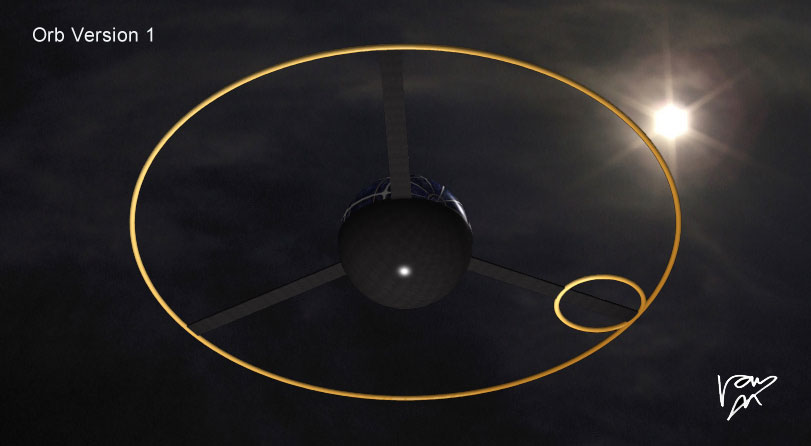
It is my hope to create a network of Orbs - Soft Radios that can cooperate to locate celestial signals. Orbs are wide-band radios that downlink to the web using TCP/IP 802.11 protocols. Orbs talk to each other to using ham, astronomy, and ISM bands in real time. Their locations in space time is computed using GPS-disciplined internal oscillators.

Saturday, September 05, 2009

Radio Light -


I’ve got hamtrak, my communications monitoring program, running more reliably. It listens on my soft radio and plots pins in Google Earth as amateur radio contacts occur. I wanted to know if there was bias in the reception I was getting due to geographic, antenna or electronic factors. I let it run for 11 hours. Then I compared the picture it produced with US population as seen from space:


For this small sample, the visual correlation appears representative.

Friday, September 04, 2009

A Solution to the North Rising Sun


Lately as I ride across the pedestrian bridge at sunrise, I have noticed the sun has been rising in the north. Having been informed that the always rises in the east, I found this perplexing. The trouble turns out to be the accumulation of two interesting factors.


1) The pedestrian bridge does not head due north, it is rotated 15 degrees towards the east. Picture:

So believing the bridge to be north-south was problem one.


2) The sun does not rise in the east. Tomorrow (9/4/2009) it rises exactly 9 degrees north of east. But back in July when I was first having the problem, it was rising 28 degrees north of east. As late as August 4, it was 21.4 degrees north of east. Moreover just before sunup, the sun is another couple of degrees north of east, when its light is beginning to fan out across the sky.


3) Accounting for the early light makes 30 degrees north + 15 degrees of bridge rotation, so the sun APPEARS to be rising at 45 degrees north of due east and that surely looked wrong. I noted this out fearing some sort of cosmological malfunction of my brain or dire state of misinformedness.


4) The sun does not rise in the east, it rises in the north east, in the summer and the south east in the winter. This is paradoxical since the winter sun rides lower in the southern sky as the northern hemisphere tilts further away from it. It rises in the east only one day of the year. This year that will be September 23 at 7 am CDT, a day after the equinox. After this the sun heads south of east for its rising reaching a of maximum southness of east of 28.6 degrees around the solstice, December 21.


5) Riding on the bridge, the sun will appear to rise in the east on Halloween morning at 7:15 am in a suitable tribute to my distress. The next day we reset our clocks introducing a new kind of biological confusion.


Monday, August 31, 2009

A Short Trek to DNA Cutter M87


Tonight I was watching the city of my old workplace, JPL, burn.


While doing so I ran across UCLA data on Messier object M87, a galaxy that contains a supermassive black hole.


I opened a certain Google Earth database built from the Ukrainian observations and found out that, indeed, this RF source is one of the brightest in the universe.

But for the first time I had a possible name for bright source GR1228... could it be M87?!


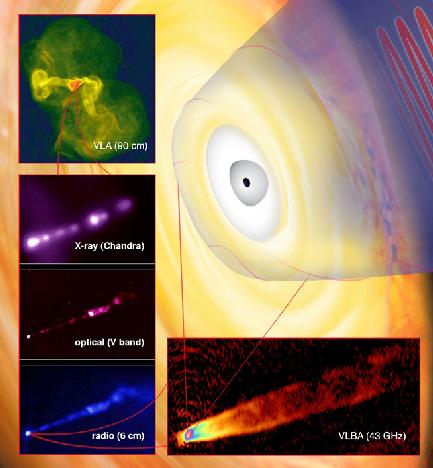
M87 is very interesting because it contains a spinning black hole that is the mass of six billion of our suns, diversely radiant in frequency and direction. It has been observed at frequencies from as low 16.7 MHz, through microwave and optical frequencies, up to gamma ray frequencies. Extremely wide band radiation. Thus, it is reasonable to assume that it is a strong cosmic ray emitter as well. As such it represents a "DNA cutter". M87 gamma rays cause the emission of ultraviolet light when the upper atmosphere of Earth is impacted.

I needed to make sure that G1228 was M87, so I did some calculations and found a discrepancy between the M87's position in Google Sky and its position in the Ukrainian radio telescope database:


Now M87 has neighbors and GR1228 has neighbors, but none are so bright in the radio spectrum.


For the time being I will assume that some kind of atmospheric refraction is at work and for pointing purposes M87 is a good starting point for listening to GR1228.

I was most curious to know the current position of M87 relative to our daily experience, so I fired up Hallo Northern Sky, a free astronomy program that does time lapse on all known planets, stars, constellations and Messier objects. Running planet and star paths, past, present and future is just amazing.


Now M87 is on a line between Arcturus and Denebola. The “Star of Joy” Arcturus is the fourth brightest star in the sky and Denebola is only 36 light-years from earth.


Today for thirteen hours M87 is exposing us to its DNA splitting radiation, starting at 9:23 AM CDT this morning and ended at 10:37 PM on a route slightly more overhead than the sun.


M87 makes a good calibration standard for celestial radio location activities.
I would like to know how fast M87 it is spinning, its strength as a cosmic ray source, what kind of antennae one might use to track it, and if it is truly the same object as GR1228.

Friday, September 14, 2007

Forte! The Loudest HF Radio Source

.


I finally got my program going for visualizing celestial radio sources. It was one of those stay-up-all-night-cause-its-too-exciting-to-sleep kinda deals. The push came at was the end of a week-long programming binge. Now its rehab time.


Here are some preliminary results, seen from several points of view. In these images, the size of the blob is the loudness of the source. The color of the blob is the spectral index. Purply blobs are blue-shifted "hot" sources. Orange-red blobs are red-shifted and thus cooler, in the radiant sense.


To give you a sense of this, here is Andromeda, by its lonesome:

Here it is hanging with its radio friends:


Some friends are louder than others:

Turns out this source is near a couple of black holes in the catalog.
One is "feasting" the other is "spewing". Quite the cosmic party.


I find that very exciting...

You can too. The Google Earth kml file may be downloaded here.

- Van

L. Van Warren MS CS, AE
web wdv.com
FCC AE License AE5CC

"Slow is Fast and Fast is Slow"

Wednesday, September 12, 2007

Third Rock: Get Your Galactic Freak On

Made some more progress getting the Ukranian RF data loaded into Google Earth.
Many of the glitches are gone and I am getting better coregistration.
Here is an example of a “possible” optical correlation with a radio source.
In galaxy zoo this would be classified as an elliptical galaxy. Perhaps it isn’t!


I still have to size the radio emitting sources by their flux, which is a little harder due to the grammar, but is coming into reach. There are a few really loud sources. I can’t wait to get my freak on them. But at 5:30 am, its probably time to go to sleep! This is so exciting, it is literally making me sick to my stomach. I am having a lot of anxiety with each step. This is very powerful stuff. Leverage. And it is so new. No eyes have ever seen this massive correlation.
Don’t know who to tell really, so you guys are it! I will release a layer soon and you can load it into Google Earth yourself!

All the red spots below are radio sources.


All the best,

- Van

L. Van Warren MS CS, AE
web wdv.com
FCC AE License AE5CC
Slow is Fast and Fast is Slow

Tuesday, September 11, 2007

Second Look: Visualizing Radio Sources

This evening's work consisted of rendering the sources as point emitters, instead of envelopes.

Here is the sky before and after visualizing radio sources:

Before:


and After:


The dark band appears to be a gap in the data.

Next tasks are to render sources by their strength or apparent radio brightness, and clear up gaps in the data.

- Van

Sunday, September 09, 2007

First Light: Windows To A New View of Space

There is a saying in telescope construction: “First Light”.

It is at that moment when one finds out if all the work will have a reward. It can be so much work. Just now, while a retrospective of Pavaroti ran on CBS, my radio telescope mapping program got its first light. I am visualizing the Ukrainian UTR-2 Radio Source Catalog.

Here are two pictures showing the sky as we used to see it, and the radio sky as we can now see it.
This is very rough, and maybe even wrong, but it shows that all the pieces can talk to each other, and that is the hard part.

Here is what the sky looked like before:


Here is “after” the first light. Each red window is a radio source. I promise to improve this, but it’s a start. There are 12,000 observations from over 2000 galaxies, quasars and galaxy clusters emitting on frequencies you can hear on a short wave radio 10 – 25 MHz. Hopefully we can do that too!


It is so exciting! Thanks to all the astronomers in the Ukraine and the engineers at Google who made my work visualizing the UTR-2 catalog possible.


Rosette Nebulae with Ukraine 10-20 Mhz Radio Windows

Saturday, September 08, 2007

Zero Point: Visualizing 16.7 MHz Celestial Radio Sources:


This evening was spent processing the Ukraine Russia Radio Telescope Database and extracting celestial coordinates, spectra and signal strengths for 16.7 MHz RF Celestial RF Emitters. Results were obtained for the following numbers of objects:

Quasars: 118
Galaxies: 142
Galaxy Clusters: 15

Subtotal: 275

Other Grade A Emitters: 749 // high quality measurements
Other Grade B Emitters: 596 // medium quality
Other Grade C Emitters: 510 // lower quality


Subtotal: 1855


Grand Total: 2130 celestial radio sources

This required many computational operations, data verification and conversion passes. Scripts were written that convert the raw catalog into a consistent, normalized and usable form.

Now that the database is ready, I intend to plot these radio sources in Google Sky so we can “see” their distribution and galactic neighborhoods. M31, Andromeda, is my focal point, but I’m very excited to have many sources to consider. Color=Frequency, Size=PointingRolloff, Brightness=Flux. It will take me a few days to produce the KML channel. Unix makes cleaning and sifting through the data much easier. This will help us know where to point our software radio antennas. Wish me luck.