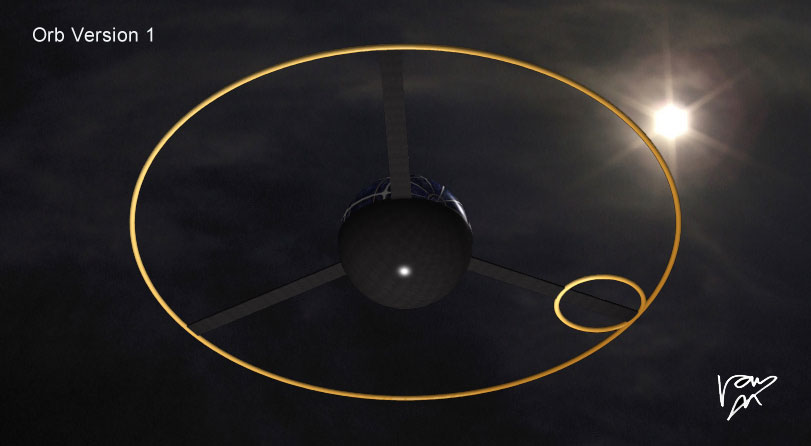
Using the light on one can see...
When any object reenters the earth’s atmosphere it gets hot. Orbital velocities are on the order of 17,000 feet per second, and much higher, and the angle of reentry determines the fate of the object. If it enters steeply, it gets hot more quickly, and the forces are much higher, on the order of hundreds of gees. These forces can break an object into smaller pieces which then proceed along their own paths. Peak heating (and deceleration) occur between 200,000 feet and 400,000 feet, the boundary of space. Objects in this region are supersonic, and become subsonic around 100,000 feet (give or take).

If an object enters at a shallow angle, it can skip off the atmosphere, much as a rock skips along a lake. It will often go back into orbit and reentry again, but at a slightly steeper angle until it encounters the fate of the first group. If it is going escape velocity, it can skip and then just go back out into another orbit, but this is not the most likely scenario.
When an object enters at an angle of between 2 and 8 degrees (give or take) it undergoes a smooth and controlled reentry, pulling only a few gees. All objects that encounter the atmosphere create a boundary layer of ionized gas. This does several things. First, it attempts to melt the skin of the object. Second it reflects RF internally. Third, and most importantly for us, the layer of ionized gas creates a streak in the sky that is an effective RF reflector. Because of the conical shape of this streak of ionized gas, the reflector does not reflect the same in all directions, the fancy word for this is anisotropic. It polarizes the RF, favoring some orientations and frequencies over others, just as your Polaroid sunglasses do.

Because this reflector is not the same size in all directions, it will favor some frequencies along its long axis and other frequencies along is short axis. One could (and may hams have) broadcast against this reflector and used it as a relay until the cloud of ionized gas cools and dissipates. But broadcasting against this reflector is not necessary, as the sky is full of signals that are already bouncing off of it, like VOR stations for example. When those signals are located using SDR, GPSDO and multilateration, they can be combined to create an image of the shape of the reflector.
This image of the shape of the reflector provides the trajectory of the reentering object. The size and frequency response of the reflector provides information about the size, position and velocity of the object. Combining this information can be used to determine where the object landed, by solving a differential equation called the initial value problem or IVP. IVP says find where the object is now, based on where you saw it last, and how it was moving.
This is how you catch a falling star.