Point 1: Maslow's Hierarchy
Read Latex
Wednesday, January 06, 2010
Duals and Duels
Point 1: Maslow's Hierarchy
Tuesday, December 15, 2009
Reading Past the End: The Knotted Universe
While completing a lecture I stumbled upon Robert Scharein's thesis:
This is knot the end. Think of milk drops. Think of cymbals. Think of resonating loops or 'strings' as in Brian Greene and String Theory. Can a string ring in different modes? Can a knotted string be ringing in different modes? Two such modes, orthogonal?
I can build a circuit or structure that will ring in several modes. But can a circuit be knotted? A loop antenna exists at the electron level and at the macro level. Such loops communicate by radiating and receiving photons. Knotted fields of energy. Perhaps deeper issues in physics, space-time and dimensionality are connected via knots.
Knots appear in organic chemistry. Left-handed glucose gives cells energy. Right-handed glucose is useless, unless you live in a world that is the mirror image of our own.
Knots appear in DNA storage on histone coils where multiple levels of recursion enable a six foot strand in each cell.
Proteins that fold correctly function properly. There are protein folding diseases. BSE (Mad Cow), Alzheimer's, Huntington's Chorea and even cataracts.
The issues of three dimensional correctness are covered with amazing clarity and brevity in this knot thesis. Knots are symbols with structure and meaning, flying all around us.
There exist symbolic algebra, symbolic geometry and symbolic topology.
Understanding how the three relate will make life easier for the implementers and students of same. Thus a rudimentary understanding of them is essential in the set of thinking primitives we require.
Monday, September 21, 2009
Delay Discounting Measures Operational Amplifier Gain
Recently I observed this as a test subject in a medical psychology experiment called "delay discounting".
These studies characterize addictive behavior by attempting to measure a person's tendency towards impulsiveness and control of same. Impulsiveness is quantified by asking the test subject questions like, "Would you rather have $50 now, or $100 in a week?", on a sliding scale where the impulsive person will take anything in the here and now, rather than pie in the sky after some interval of time. Delay discounting behavior is a useful window into addictive and other human behaviors. Consider the show Survivor, where the contestants will pay $500 for a hamburger if they can have it right now, even if it means risking a million dollars in a few days.
In delay discounting there are four categories of questions. Gain and loss versus time, like the question above, and gain and loss versus certainty of reward.
The stunning (to me at least) observation is that after a subject answers these questions, they have effectively calibrated the gain curves on four specific operational amplifiers.
Amplifiers take small signals as inputs, and subject to variables like feedback, gain setting, and stability, produce large signals as outputs. There is a saying in electrical engineering that, "Amplifiers Oscillate and Oscillators Amplify". One may extend that saying to the world of digital filters to say, "Filters Amplify and Amplifiers Filter".
Without going into an incredibly boring tirade, let me just provide a few assertions that apply to the amplifier model.
1) Clusters of neurons sum their inputs to produce an overall action, and this is similar to amplifying a small input to produce a large output.
2) Different clusters of neurons, responsible for different activities, have different gain settings. The gain settings of these clusters can be imaged using techniques like fMRI and PET.
3) After measuring an individual's gain curves, one could actually predict (the thesis of the delay-discounting world) their propensity to engage in various addictive behaviors.
4) One an individual is characterized, one could simulate the behavior of that person with an analog or digital amplifier.
5) One could create an electronic implant to control addictive behaviors in willing individuals that are afflicted. (Implants in the unwilling are beyond the modest scope of this note!)
Addictive behaviors have a wide range of expression and involve substance and non-substance stimuli (gambling for instance). Basal ganglia disorders like Obsessive-Compulsive Disorders or OCD, may also involve the brain centers connected to addition.
Whether addictive disorders are architectural from brain morphology, neurochemical from nerve cell receptor distribution, or both, I do not know. What I do know is that the amplifier model can be very useful for characterizing both the likelihood and the expression of the behavior in individuals for which the measurements have been properly made.
In that sense, delay discounting measurements provide what engineers call, "A Characterization of the Amplifier".
This would certainly seem a useful model for characterizing behavior, in my mind at least.
Ref: Eisenberg et al. Behavioral and Brain Functions 2007 3:2 doi:10.1186/1744-9081-3-2
Sunday, September 20, 2009
Boosting the Shuttle to Geosynchronous Orbit
Wednesday, September 16, 2009
Tracking the 100 Brighest Satellites
Sunday, September 13, 2009
Saturday, September 05, 2009
Radio Light -
I’ve got hamtrak, my communications monitoring program, running more reliably. It listens on my soft radio and plots pins in Google Earth as amateur radio contacts occur. I wanted to know if there was bias in the reception I was getting due to geographic, antenna or electronic factors. I let it run for 11 hours. Then I compared the picture it produced with US population as seen from space:


For this small sample, the visual correlation appears representative.
Friday, September 04, 2009
A Solution to the North Rising Sun
Lately as I ride across the pedestrian bridge at sunrise, I have noticed the sun has been rising in the north. Having been informed that the always rises in the east, I found this perplexing. The trouble turns out to be the accumulation of two interesting factors.
1) The pedestrian bridge does not head due north, it is rotated 15 degrees towards the east. Picture:
So believing the bridge to be north-south was problem one.
2) The sun does not rise in the east. Tomorrow (9/4/2009) it rises exactly 9 degrees north of east. But back in July when I was first having the problem, it was rising 28 degrees north of east. As late as August 4, it was 21.4 degrees north of east. Moreover just before sunup, the sun is another couple of degrees north of east, when its light is beginning to fan out across the sky.
3) Accounting for the early light makes 30 degrees north + 15 degrees of bridge rotation, so the sun APPEARS to be rising at 45 degrees north of due east and that surely looked wrong. I noted this out fearing some sort of cosmological malfunction of my brain or dire state of misinformedness.
4) The sun does not rise in the east, it rises in the north east, in the summer and the south east in the winter. This is paradoxical since the winter sun rides lower in the southern sky as the northern hemisphere tilts further away from it. It rises in the east only one day of the year. This year that will be September 23 at 7 am CDT, a day after the equinox. After this the sun heads south of east for its rising reaching a of maximum southness of east of 28.6 degrees around the solstice, December 21.
5) Riding on the bridge, the sun will appear to rise in the east on Halloween morning at 7:15 am in a suitable tribute to my distress. The next day we reset our clocks introducing a new kind of biological confusion.
Monday, August 31, 2009
A Short Trek to DNA Cutter M87
Tonight I was watching the city of my old workplace, JPL, burn.
While doing so I ran across UCLA data on Messier object M87, a galaxy that contains a supermassive black hole.
I opened a certain Google Earth database built from the Ukrainian observations and found out that, indeed, this RF source is one of the brightest in the universe.
But for the first time I had a possible name for bright source GR1228... could it be M87?!
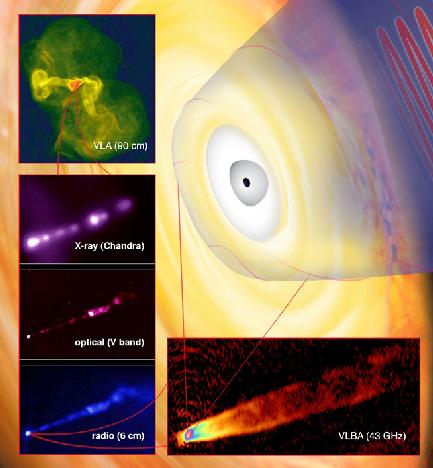
M87 is very interesting because it contains a spinning black hole that is the mass of six billion of our suns, diversely radiant in frequency and direction. It has been observed at frequencies from as low 16.7 MHz, through microwave and optical frequencies, up to gamma ray frequencies. Extremely wide band radiation. Thus, it is reasonable to assume that it is a strong cosmic ray emitter as well. As such it represents a "DNA cutter". M87 gamma rays cause the emission of ultraviolet light when the upper atmosphere of Earth is impacted.
I needed to make sure that G1228 was M87, so I did some calculations and found a discrepancy between the M87's position in Google Sky and its position in the Ukrainian radio telescope database:
Now M87 has neighbors and GR1228 has neighbors, but none are so bright in the radio spectrum.

For the time being I will assume that some kind of atmospheric refraction is at work and for pointing purposes M87 is a good starting point for listening to GR1228.
I was most curious to know the current position of M87 relative to our daily experience, so I fired up Hallo Northern Sky, a free astronomy program that does time lapse on all known planets, stars, constellations and Messier objects. Running planet and star paths, past, present and future is just amazing.

Now M87 is on a line between Arcturus and Denebola. The “Star of Joy” Arcturus is the fourth brightest star in the sky and Denebola is only 36 light-years from earth.

M87 makes a good calibration standard for celestial radio location activities. I would like to know how fast M87 it is spinning, its strength as a cosmic ray source, what kind of antennae one might use to track it, and if it is truly the same object as GR1228.
Tuesday, August 18, 2009
A Fence In Space...
For the past couple of days I have been listening to satellite crossings from the Kickapoo Space Radar. NAVSPASUR is part of the North American “Fence” that operates along the a great circle fan crossing the US. The "post" in Kickapoo is at latitude 33.558, the second tack to the left of my home in Little Rock (the red tack).
One can listen to objects crossing the radio fence using Stan Nelson’s station in Roswell, New Mexico. The broadcast is in real time.For a real treat, the NASA Java Applet JTRACK-3D allows one to view which of 900+ satellites are in crossing the fence at any given time.


When a space borne object crosses the fence it chirps. With practice one can distinguish satellites from meteors. An audio chirp and no satellite, means a meteor or a satellite crossed that isn’t in the public database. I heard two while writing this sentence. Notice that the four platforms above all have orbital periods of around 100 minutes.
Platforms which cut obliquely like ORBCOMM FM 36 have a different audio signature than those with highly inclined polar orbits due to their longer dwell time in the RF swath. To some degree the chirps are unique and I wonder if a blind person could actually get to where they knew the satellite by its chirp. Locals will be happy to know that there is a “post” in the space fence at Red River Space Surveillance Station, AR, near Texarkana.

To Catch A Falling Star...
When any object reenters the earth’s atmosphere it gets hot. Orbital velocities are on the order of 17,000 feet per second, and much higher, and the angle of reentry determines the fate of the object. If it enters steeply, it gets hot more quickly, and the forces are much higher, on the order of hundreds of gees. These forces can break an object into smaller pieces which then proceed along their own paths. Peak heating (and deceleration) occur between 200,000 feet and 400,000 feet, the boundary of space. Objects in this region are supersonic, and become subsonic around 100,000 feet (give or take).
If an object enters at a shallow angle, it can skip off the atmosphere, much as a rock skips along a lake. It will often go back into orbit and reentry again, but at a slightly steeper angle until it encounters the fate of the first group. If it is going escape velocity, it can skip and then just go back out into another orbit, but this is not the most likely scenario.
When an object enters at an angle of between 2 and 8 degrees (give or take) it undergoes a smooth and controlled reentry, pulling only a few gees. All objects that encounter the atmosphere create a boundary layer of ionized gas. This does several things. First, it attempts to melt the skin of the object. Second it reflects RF internally. Third, and most importantly for us, the layer of ionized gas creates a streak in the sky that is an effective RF reflector. Because of the conical shape of this streak of ionized gas, the reflector does not reflect the same in all directions, the fancy word for this is anisotropic. It polarizes the RF, favoring some orientations and frequencies over others, just as your Polaroid sunglasses do.
Because this reflector is not the same size in all directions, it will favor some frequencies along its long axis and other frequencies along is short axis. One could (and may hams have) broadcast against this reflector and used it as a relay until the cloud of ionized gas cools and dissipates. But broadcasting against this reflector is not necessary, as the sky is full of signals that are already bouncing off of it, like VOR stations for example. When those signals are located using SDR, GPSDO and multilateration, they can be combined to create an image of the shape of the reflector.
This image of the shape of the reflector provides the trajectory of the reentering object. The size and frequency response of the reflector provides information about the size, position and velocity of the object. Combining this information can be used to determine where the object landed, by solving a differential equation called the initial value problem or IVP. IVP says find where the object is now, based on where you saw it last, and how it was moving.
This is how you catch a falling star.
Thursday, July 02, 2009
EVCalc2: A Calculator for Electric Vehicles
Who has time to read? You can just download the calculator here.
If you want to know how it came about, the story goes like this: About four years into my engineering career at NASA's Jet Propulsion Laboratory, I got the chance to attend a series of lectures put on by Aerovironment at Caltech. Aerovironment was an early green company, maybe the first with a lineup of such heavy hitters. The lectures were entitled the "Sunraycer Lectures". They detailed how Aerovironment had won the Australian Solar Race in a car called "Sunraycer". For a final, attendees got to do a design, I did a solar-to-steam car design intended to work around the low efficiency of solar cells and built a scale-model, but I'm getting ahead of myself.
Peter, as in Dr. Lissaman - had a famous gliding airfoil named after him. He opened with a lecture about GMR method, which stood for Goal-Method-Result. I never met Sir Edmund Hillary, the first conquerer of Everest, but Peter looked and sounded like Sir Edmund to my imagination with his bold declarations and British accent. Lissaman had decided to fair the flow at the rear of the Sunraycer with "chines", discrete panels that would allow the solar cells to be attached without bending them excessively. Later designs would smooth the tail completely, but the shape was interesting and met the fabrication needs of the time. It also made for a car with an extremely low drag coefficient, 0.125, the lowest ever achieved at that time.
Ray Morgan was a down-to-earth engineer who talked about how Kevlar was better than Boron composites if you're in the ER after an experimental aircraft crash, because they "don't have to pick the boron splinters out of you one at a time". Ray could build stuff, in that enigmatic Mythbuster's sort of way. He talked about "Hot Shot" glue, a methacrylate glue that allowed you to put things together fast in a prototype and how you could pound the ends of fine tubing with a hammer so you could drill and fasten them together with a bolt. He is shown here shaking hands with Burt Rutan. Morgan is on the right.Now all this took place in the context of yours truly bicycling back and forth to work, and I got really tired of breathing LA exhaust fumes, which drifted north to Pasadena and clung in an opaque and stupefying fog that hid the mountains that would light on fire from time to time.
After finishing the course, it all seemed kind of straightforward, except for the two-million dollar part. It came about that a certain fellow and I cooked up a scheme by which we might retrofit existing cars by removing their internal combusion engines and replacing them with a drop-in "electric-car conversion." We picked the Geo Storm as a starting point because it was trendy and quasi-aerodynamic. The sales guy was more than happy to hear this.
So I decided to take the basic parameters of an electric electric car, including hybrid APU's and solar panels if desired and codify them as a set of calculations. The sophistication comes from the number of related issues, "pushing on this pulls on that".Those calculations can save you a great deal of pain, dollars on the cutting-room floor, and get you closer to realizing the ideal of a practical electric or hybrid electric car. I ask a few dollars for the software, but according to my experience, its a pittance compared to $30,000...
Van / wdv.com
Tuesday, June 30, 2009
Filamentary Rotations
A degree of freedom is something like movement in the x-direction. Move over, move back. This degree of freedom is big, because we can see the movement if it is large enough.
So we might call this idea of a freedom of movement in the x-direction a dimension.
A line of this movement, or a filamentary curve is something we can slide a bead along. We assume that we can label subsequent positions of the bead as we move over and move back, and if these labels are consecutive numbers, we can use them to say where we were, where we are, and where we will be.
This filament of possible movement is so large we will call it a large dimension - a large degree of freedom.
But now take the bead and twirl it. The bead can also have another degree of freedom, a rotation.
But assume for a moment that we allow the bead to shrink, ever smaller and smaller, till it is just the size of the filamentary curve itself. We can talk about the rotational station of this bead, but the degree of freedom itself is curled up, too small to see, so we might call this a small dimension - a small degree of freedom.
We can also think about labeling how curled up the bead is by naming the turns or parts of a turn the bead has made. If these names are consecutive numbers we can use them to say where we were, where we are, and where we will be.
Now we are ready to talk about the first idea.
If we have something that is moving in a large dimension along a curve or line, we can resolve this movement as movements along a set of complementary axes. Then we can say that movement along our arbitrary filamentary curve has this much movement in the x-direction, this much movement in the y-direction, and we can use these pairs of labels as perfectly adequate alternative names for the position of the bead along the arbitrary filament.
If you have ever spun a bicycle wheel and held onto the axle in each hand, you will know that the wheel doesn't like to be tilted. It resists this tilting with an inertial force called the gyroscopic force. The gyroscopic force wants to keep the wheel spinning in its original direction and complains by resisting if the wheel is tilted to spin in some other plane of rotation.
All the points on the wheel except the very center, can be represented as translations through space, they aren't rotating at all! But the very center of the wheel (we pretend the axle is rotating too) has an axle, an axis of rotation, and there is an infinitesimally-wide dimension where the movement is pure rotation with no translation. This is a small dimension, because it can never be seen. A more apt name for it might be an invisible dimension.
If the bicycle wheel became like the bead, and became infinitely small, it would have no gyroscopic force. So it could be spinning in one direction, and then that whole assembly could be spun in a second direction and we could resolve spins in one direction into components of spins in multiple other directions as we did with translation above.
Now for the second idea.
If we count up the directions that we live in there are three, and for each of these directions there are three rotational degrees of freedom. Then there is the passage of time. So we really live in a six dimensional sort of space, if we count the invisible dimensions of filamentary rotation, seven if we consider time to be a dimension, but it doesn't have the same freedom as the others. We are stuck in it.
The third idea.
I should stop here, but I am afraid I might lose an important idea, so I will just add something that I find interesting. We rarely talk about the position of a photon. We can talk about where it originated, or where it might be after a time, but the native state of a photon is not really its position, but rather its velocity, which in a vacuum is just c - the speed of light.
But this is a translational velocity and I want to know if there is also some kind of native rotational velocity of a particle, say a photon, or even some other kind of a fundamental building block, perhaps an electron. The spin of an electron is one of its four pieces of state information. My question is, how fast is it spinning?
So putting the last two ideas together we see that it isn't just where something is that is its native state, but rather how fast it is going that characterizes something important about it. How fast something goes is a degree of freedom - a dimension also.
If we add up where things are, and how fast they are going in translation and rotation we come up with 12 degrees of freedom, or 12 dimensions. That plus time makes 13, which just happens to be my lucky number...
Monday, June 29, 2009
An Excerpt from Ham Radio Field Day 2009
Because of an exhausting 50 mile bike ride in the hot sun, I couldn't make it to Field Day on Saturday. I woke up late on Sunday, hoping to make some kind of belated appearance.
Just for fun, I started my HamTrack system at 9:47 am - a mashup of Google Earth, CW Skimmer, and C++ programs, glued together with some Unix tools, sed, grep, awk, along with the usual database fiddling and geolocating.
It is an end-to-end automated signal tracking system that translates RF morse code into pins on a map. So I left it running and headed over to the real Field Day, where, after catching up with my buds, I managed an impressive 2 contacts 15 minutes before the end of the event at 1 PM.
When I got home I discovered that 308 stations made 917 calls while I was gone, illustrated as pins in a map below. As in the 24 hour case, (previous blog), pins are colored by frequency, red for 6.9 MHz, blue for 7.1 MHz and spectral coloring in-between. My pin AE5CC is arbitrarily assigned red so I can find it in the sea of pins.
You will need the Google Earth browser plug-in to view the interactive map, and it takes a few seconds to load the data - about the time it takes to read this. If you don't use Google Earth, you're missing the best thing since sliced bread. - AE5CC
Monday, June 15, 2009
An Extreme Soft Radio Adventure - 24 Hrs @ 7 Mhz
After some antenna simulations using 4Nec2 (by Arie Voors) I wrapped a wire around my townhouse to create a loop HF antenna. I was curious if it was working and how the actual propagation pattern compared to my predictions. So I left my software defined radio, a Softrock 6.2 (by Tony Parks and Bill Tracey), running for 24 hours. It turned out to be quite an adventure!
Results: 1138 stations made 4907 calls, illustrated as pins in a map below. The pins are colored by frequency, red for 6.9 MHz, blue for 7.1 MHz and spectral coloring in-between.
Mouse over the map to see calls from the Island of Midway to Puerto Rico in longitude, from Alaska to Florida in latitude.
You will need the Google Earth browser plug-in to view the map, and it takes a few seconds to load the data - about the time it takes to read this. If you don't use Google Earth, there is an image at the bottom of the page. - AE5CC